

EN
Radiation safety. Dosimetry of ionizing radiation.
The primary process that initiates a sequence of physical and chemical transformations in the irradiated substance and leads to the observed radiation effects is the absorption of ionizing radiation energy.
Accordingly, first of all, it is necessary to compare the observed effects with the amount of absorbed energy, which is characterized by the absorbed dose. The absorbed dose (D) is the amount of energy of ionizing radiation absorbed in a unit mass of any irradiated substance:
D = dE/dm (1)
where: dE is the average energy transferred by ionizing radiation to a substance located in an elementary volume, dm is the mass of the substance in this volume.
Energy can be averaged over any given volume, in which case the average dose is equal to the total energy transferred to the volume divided by the mass of that volume. In SI units, the absorbed dose is measured in joules per kilogram (J/kg) and has a special name, Gray (Gy) .
1 Gy = 1 J/kg
The non-systemic unit rad is still used . In English transcription it is rad (radiation adsorbed dose).
1 rad = 0.01 Gy
Different types of ionizing radiation have different biological effects with the same absorbed dose. To assess the possible damage to human health under conditions of chronic irradiation under the influence of different types of radiation, the concept of equivalent dose was introduced.
Equivalent dose (HT,R) is the absorbed dose in an organ or tissue multiplied by the appropriate weighting factor for a given type of radiation, WR:
HT,R = WR*DT,R (2)
where: DT,R is the average absorbed dose in an organ or tissue T , WR is the weighting factor for radiation R. The unit of equivalent dose is Sievert ( Sv) [Non-systemic unit rem (biological equivalent of roentgen) , English transcription rem (roentgen equivalent in man)
1 rem = 0.01 Sv
The weighting factors for individual types of radiation in calculating the equivalent dose (WR) take into account the relative effectiveness of different types of radiation in inducing biological effects. Previously, they were also called quality factors. Table 1 shows the weighting factors for different types of radiation.
To assess the risk of occurrence of remote consequences of irradiation of the whole human body and its individual organs and tissues taking into account their radiosensitivity, an effective dose is used. The effective dose (E) is the sum of the products of the equivalent dose in organs and tissues by the corresponding weighting factors:
E=ΣT(WT*HT,R) (3)
HT,R - equivalent dose in organ or tissue T, WT - weighting factor for organ or tissue T. Unit of effective dose - Sievert (Sv) .
Currently, equivalent doses are used to assess radiogenic risk, and the effective dose is used to regulate irradiation when ensuring radiation safety.
Weighting factors (WR) for different types of radiation. Table 1

Weighting factors (WT) for tissues and organs in calculating the effective dose. Table 2 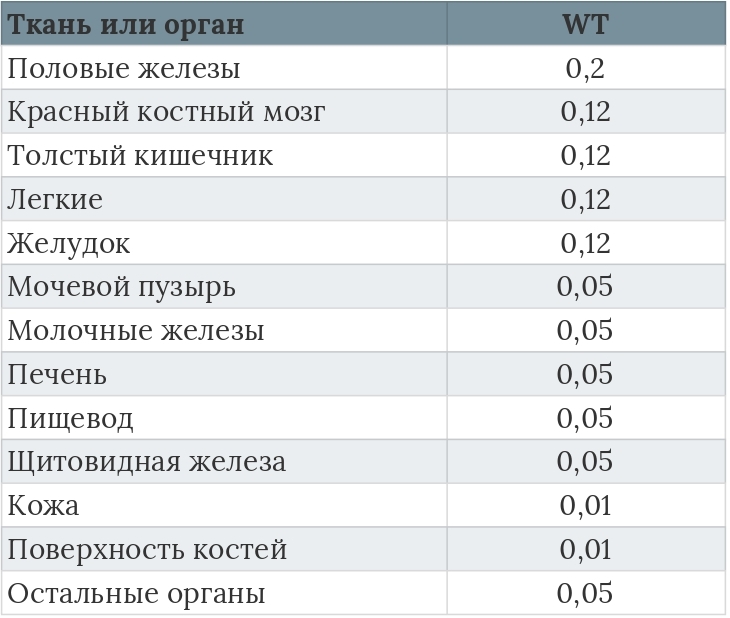
Kerma (kinetic energy released in material) is used as a quantitative measure of the interaction of indirectly ionizing radiation (γ-quanta, neutrons) with matter.
K = dE/dm (4)
dE is the total kinetic energy of charged particles released in an elementary volume; dm is the mass of this volume. The unit is Gray (Gy). For low-energy γ-quanta (E<10 MeV), kerma is approximately equal to the absorbed dose; however, for higher-energy photons, kerma and the absorbed dose begin to differ. This is due to the fact that secondary high-energy electrons can leave the absorbing volume, and some of them can also lose some energy through bremsstrahlung. This energy is taken into account in kerma and is not taken into account in the absorbed dose.
Exposure dose is also commonly used as a quantitative characteristic of X-ray and γ-radiation. Exposure dose is calculated as the charge of secondary particles (dQ) formed in the mass of matter (dm) with complete deceleration of all charged particles:
X=dQ/dm (5)
The unit of exposure dose in the SI system is coulomb/kg [C/kg]. The best known non-SI unit of exposure dose is the Roentgen (R). A Roentgen is an exposure dose of X-ray and γ-radiation that creates a total charge of ions of the same sign in one electrostatic unit of electricity in 1 cm3 of air at a temperature of 0°C and a pressure of 760 mm Hg. An exposure dose of 1 R corresponds to 2.08*109 ion pairs. The relationship between the units of exposure dose is as follows: 1R=2.58*10-4 C/kg or 1 C/kg=3.88*103 R.
The table shows the relationships between SI units and non-systemic units withdrawn from circulation in the field of radiation safety.


