

EN
Nickel ores
Nickel ores are a type of minerals containing nickel, such that its extraction is economically profitable given the current development of industry. The main nickel deposits being developed include sulfide nickel ores of 1-2% Ni and silicate ores containing up to 1% Ni. The most common nickel minerals include:
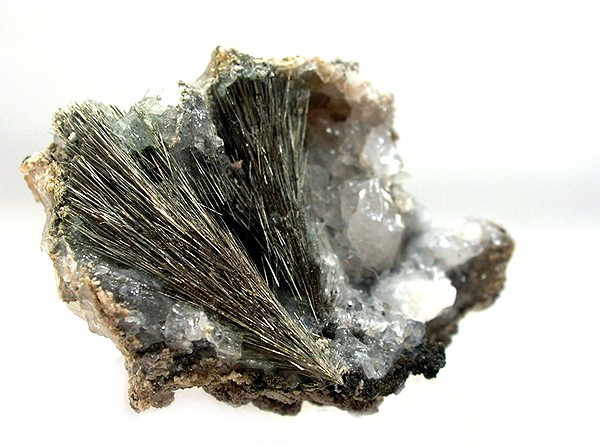
- pentlandite (Fe, Ni)S or (Ni,Fe) 9 S 8 the nickel content of which is 22-42%. The color of pentlandite is from bronze-yellow to brown, gray, see Fig. 1. The mineral is very fragile, dissolves HNO3. Ni is easily weathered with dimethylglyoxime;
- Millerite NiS (64.5% Ni). Good conductor of electricity. Contains Fe, Co, Cu as impurities. Color – brass yellow;
as well as nickelite, nickel-pyrrhotite, polydymite, violarite, etc.
Fig. 1. Petlandite

Fig.2 Millerite
Nickel ore deposits are divided into:
- Magmatic sulfide copper-nickel deposits.
- Nickel silicate ores of weathering crusts.
Sulfide ores are mined by open-pit and underground methods. Sulfide ores are enriched by flotation to produce nickel, copper and pyrrhotite or collective (copper-nickel) concentrate.
The main deposits of sulphide nickel (copper-nickel) ores include: Pechenka, Talkhan and Norilsk (Russia); Lynn Lake, Gordon Lake, Sudbury and Thomson (Canada); Kambaldna and Agnew (Australia).
The world nickel reserves are estimated at 190-200 million tons. Nickel reserves are distributed very unevenly around the world, so against this background, countries with huge nickel reserves stand out, first of all New Caledonia and Cuba (20 million tons each), Indonesia and Canada (10 million tons each) have very large nickel reserves. Another 18 countries have nickel reserves from 1 to 10 million tons, which together make up 46.2% of the world reserves. Nickel mining is carried out in 22 countries, with the leaders in nickel mining being: Russia (in 1997, the volume of production amounted to 21.9% of the world production), Canada (18.6%).
In Russia, the main sources of nickel are copper-nickel ores (70% of total production), and the rest is from oxidized (silicate) nickel ores. Sulfide copper-nickel ores are mined in the Krasnoyarsk Territory and the Kola Peninsula. Enterprises mining sulfide copper-nickel ores are united in the RAO Norilsk Nickel concern. Oxidized nickel ores are mined mainly in the Urals, including such plants as Yufuralnikel, the Ufaleynikel Association, etc.
Nickel is the basis of most "superalloys", as it is very often used in alloying steels to obtain improved strength and heat-resistant characteristics. Therefore, the turnover of nickel production in the world will only grow.


