

EN
Ore flotation
The extracted ores of non-ferrous metals are usually poor and most of them are waste rock. One of the main methods of ore enrichment is flotation. The method is based on the difference in the wettability of particles.
Flotation is one of the methods of mineral enrichment, which is based on the different ability of elements to be retained on the interphase surface (the interface between two media), due to the difference in specific surface energies. Due to such distinctive properties, particles of mineral elements are divided into two types:
- Hydrophobic particles are those that are poorly wetted by water, i.e. they tend to avoid contact with it. An example of the manifestation of hydrophobic properties is the behavior of water collected on tree leaves or grass (Fig. 1). The water takes a rounded shape and remains motionless, i.e. it does not spread, as usually happens. The same thing happens with particles of minerals and ores that have undergone crushing and grinding processes. These particles, often found in liquid solutions, exhibit their hydrophobic properties by trying to combine with air molecules or other gases in order to float to the surface and reduce their energy.
- Hydrophilic – particles that are well wetted by water when in solutions and suspensions.
Thus, hydrophobic particles tend to connect with air molecules, or more precisely, with air bubbles, in order to float to the surface - this property is used in the separation of mineral components. However, adhesion to air bubbles is not the only process by which hydrophobic particles can get rid of excess energy. Various oils have similar properties. Oil poured into a glass of water will float to the surface because oil is also a hydrophobic compound.
Ore enrichment by flotation
Flotation methods are differentiated by the type of interface created to separate the ore components. They are:
- Oil flotation. Mixing crushed ore with oil and water, causing sulphide minerals, which are poorly wetted by water, to float to the surface.
- Froth flotation . Flotation in which air bubbles are passed through a mixture of particles and water, after which foam saturated with the components being floated forms on the surface. This foam is then separated from the liquid and then dried.
To carry out froth flotation, the ore must be crushed to 0.1-0.2 mm.
However, not all valuable ore components have sufficient hydrophobicity for extraction. Conversely, elements of gangue may have more pronounced hydrophobicity than valuable ore components. For this purpose, there are special chemical compounds called reagents. Reagents are substances that increase or decrease the hydrophobic/hydrophilic properties of particles. Depending on their properties, reagents are divided into the following categories:
- Collectors are substances that are sorbed on the surface of the metal that must be extracted from the solution (converted into foam).
- Regulators have the opposite effect and, on the contrary, increase the hydrophilic properties of individual particles, as a result of which the latter become incapable of flotation.
- Foaming agents provide stability to mineralized foams.
- Activating reagents are reagents that create conditions that favor the attachment of collectors to the surface of minerals.
- Depressant reagents are reagents used to prevent mineral hydrophobization by collectors. They are designed to increase the selectivity of flotation when separating minerals with similar flotation properties.
Flotation reagents are expensive raw materials. For automatic control of the reagent mode of the flotation process, it is necessary to determine the quantitative content of various elements in the pulp in real time. For these tasks, the ARP-1C flow X-ray fluorescence analyzer is used , which is capable of determining the concentration of elements from Ca to U in the pulp pipeline.
Flotation processes play a very important role in enriching ores of various elements. Foam flotation has the greatest efficiency, which is why it has become the most widespread.
Before flotation enrichment, the ore is crushed in special mills, turning the ore into a charge consisting of valuable ore particles and waste rock. For high-quality flotation, it is necessary to select a degree of crushing that ensures a sufficiently complete separation of minerals. Grains of 0.1-0.04 mm in size are best separated by flotation. Smaller particles are separated worse, and particles smaller than 5 microns impair the flotation of larger particles. The negative effect of micron-sized particles is reduced by specific reagents. Large (1-3 mm) particles are torn away from the bubbles during flotation and are not floated.
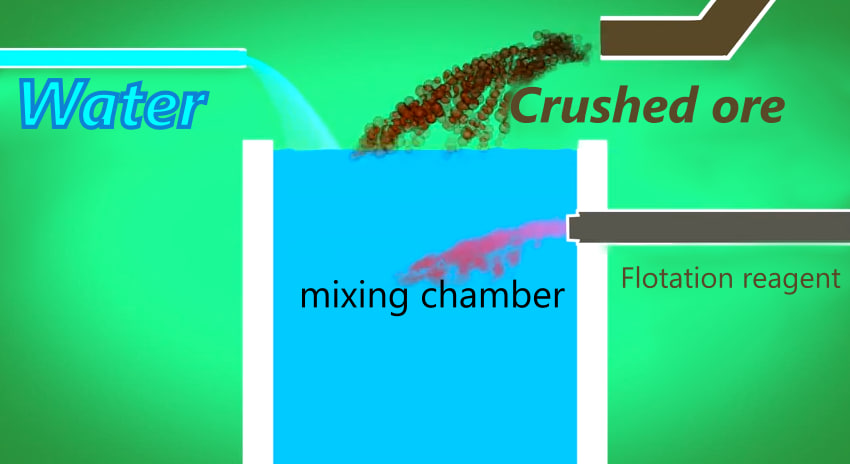
In the first stage of flotation, the crushed ore is mixed with water in the mixing chamber, forming a pulp (a mixture of ore particles and waste rock in water). At the same time, a flotation reagent is added to the chamber, which wets only the valuable ore particles, but not the waste rock.
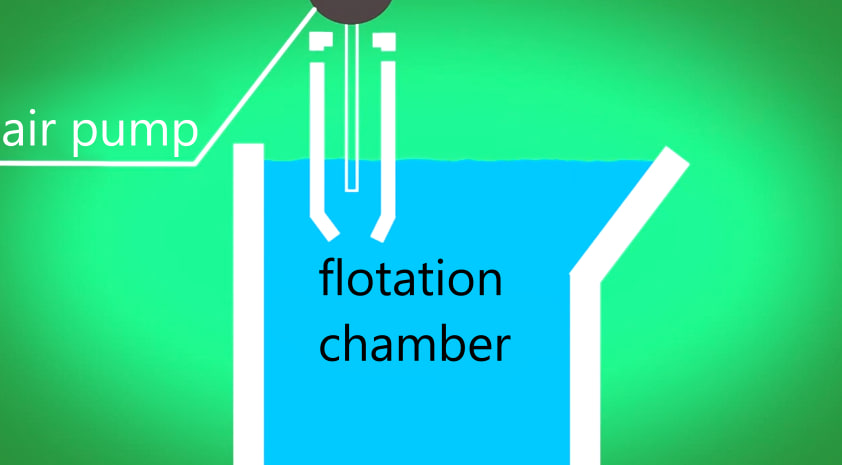
The pulp then enters a flotation machine, into which air is supplied using a pump.
As they float, air bubbles meet grains of valuable ore and grains of valuable rock. When a particle of valuable ore covered with a layer of flotation reagent meets an air bubble, the water, without wetting the reagent, rolls off the surface of the particle and the particle approaches the bubble (is attached).
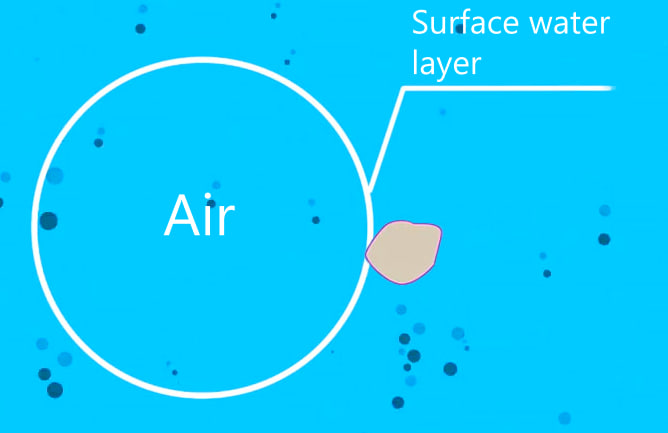
The grains of waste rock are wetted with water and do not stick to them. Air bubbles float up together with valuable ore, forming foam with valuable ore. The aggregate consisting of solid particles and air bubbles (or any gas) is called an aeroflocule .
The pulp then enters a settling tank, where particles of waste ore settle, and the foam with valuable ore moves into a receiving bin. In it, the air bubbles burst and the valuable ore settles to the bottom.

Flotation is also used to purify water from organic substances (oil, grease), bacteria, finely dispersed salt sediments, etc. This type of enrichment is also used in the food, chemical and other industries to purify industrial wastewater, accelerate settling, separate solid suspensions and emulsify substances, etc.
The flotation method is constantly being improved in the following ways:
- synthesis of new types of flotation reagents;
- design of flotation machines;
- replacement of air with other gases (oxygen, nitrogen);
- implementation of systems for controlling the parameters of the liquid phase of flotation pulp.
Flotation enables the use of finely disseminated ore deposits in industrial production and ensures the comprehensive use of minerals.


