

EN
Comparison of radiation sources
There are natural and artificial sources of X-ray radiation.
Artificial sources of X-ray radiation are X-ray tubes. The structure of the tube is shown in the figure.
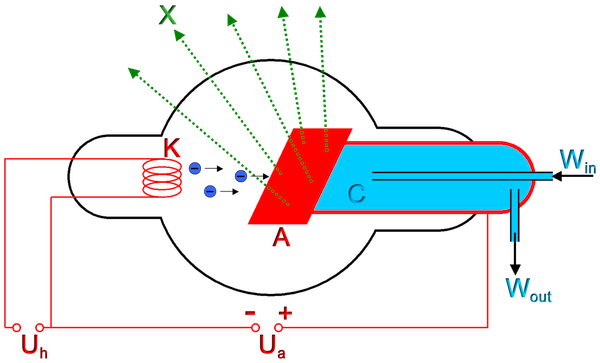
An X-ray tube is an evacuated glass flask with two electrodes: an anode A and a cathode K, between which a high voltage U (1-500 kV) is created. The cathode is a spiral heated by an electric current. Electrons emitted by the heated cathode (thermionic emission) are accelerated by the electric field to high speeds (this is what high voltage is needed for) and hit the anode of the tube. When these electrons interact with the anode substance, two types of X-ray radiation arise: bremsstrahlung and characteristic.
The working surface of the anode is positioned at an angle to the direction of the electron beam in order to create the required direction of the X-rays.
Approximately 1% of the electron kinetic energy is converted into X-rays. The rest of the energy is released as heat. Therefore, the working surface of the anode is made of a refractory material.
Advantages
- X-ray tubes make it possible to create more sensitive devices.
- Significant simplification of the procedure for obtaining permits for the operation of devices;
- Possibility to control radiation (turn on/off).
Flaws
- The X-ray tube requires fairly bulky and expensive equipment to operate. Typically, a transformer and cooling system are needed to operate an X-ray tube, but there are portable analyzers that use less powerful tubes that can operate on battery power.
- The energy of the X-ray emitter is unstable, as it depends on the ambient temperature, fluctuations in the mains voltage, etc.
- High cost with low mean time between failures.
Natural sources of X-rays include some radioactive isotopes (for example, Cd-109, Fe-55, Am-241).
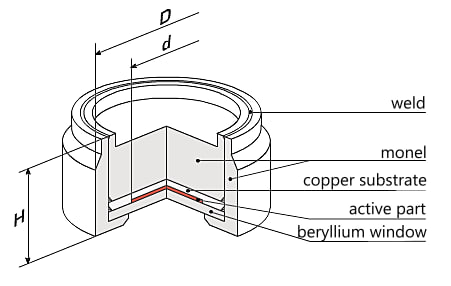
Advantages
- Equipment based on radionuclide excitation sources is compact and lightweight, which allows it to be easily integrated into process lines for automation and process control, as well as to create mobile analyzer devices.
- Unlike X-ray tubes, radionuclide sources have absolute stability of the energy spectrum, which ensures better measurement metrology.
- The radionuclide source has a line spectrum with selective energy, which is needed to excite the spectrum. All emitted photons are used as working ones to excite characteristic radiation. In an X-ray tube, most of the X-ray spectrum (with energy below the K-edge of absorption), since it represents the spectrum of bremsstrahlung, goes to radiation irradiation of the environment. This irradiation significantly increases the radiation background in the working area and, accordingly, requires more serious protection of the premises and service personnel (during calibration of the device, etc.) than when using radionuclide sources.
- The use of sources is more economical. As customers who have been using devices with sources for many years say - "We installed them once and forgot about this problem for 10 years!"
Flaws
- One of the disadvantages of radionuclide sources is the inability to change the radiation energy.
- The need to obtain permission to operate devices from Rostekhnadzor.
Conclusions
There is a biased attitude towards X-ray fluorescence devices based on radionuclide sources. Many equipment distributors claim that Europe, the USA and Japan have long abandoned sources in favor of X-ray tubes, but this is not entirely accurate information. For example, portable analyzers Thermo Scientific Niton XL3p and Heuresis P200i XRF Lead Paint Analyzer based on radionuclide sources are widely used in Europe. The advantages of an X-ray tube (the ability to switch off and, as a result, "control" the radiation) are lost when it comes to industrial analyzers that operate 24 hours a day. It is also worth paying attention to the service life of the X-ray tube. When conducting continuous round-the-clock analysis, an X-ray tube cannot compare with sources in terms of stability, reliability and mean time between failures.
Until recently, a license was required to work with all types of radiation sources. But not all sources are equally dangerous to humans. Therefore, a law was passed according to which sources are categorized. ARP-1C contains sources of hazard categories 4 and 5 (the danger to humans is unlikely). For this type of sources, only registration of organizations operating radiation sources containing only radionuclide sources of the fourth and fifth categories of radiation hazard is required.


