

EN
Copper-zinc ores
Copper-zinc ores are a complex of copper, zinc and iron sulfides and host rock minerals. Copper sulfides are usually represented by chalcopyrite, chalcocite, covellite and bornite. Iron sulfides are pyrite, carcasite and pyrrhotite. Zinc sulfides are various varieties of sphalerite, such as cleiophane.
The difficulties of enriching copper-zinc ores are due to:
1) complex and very close intergrowth of some sulphides, which indicates the need for fine grinding (up to 0.04 mm). However, the need for appropriate grinding of ore also has its limits, thus, with the existing grinding technology, half of the copper and zinc losses in tailings and different concentrates are due to intergrowths, while the other half is due to overgrinding.
2) The similarity of flotation properties of copper sulfides and zinc sulfides activated by copper ions. Both cases are characterized by the formation of copper-containing compounds of the collector on the surface. The destruction and prevention of the formation of such compounds on zinc sulfides (under selective flotation conditions) requires fine adjustment of the ratio of reagent concentrations in the pulp.
3) Different flotation of different copper and zinc sulphides (the reason is the differences in the nature of their surface, oxidation ability, etc.)
4) Inconstancy of the material composition of ores in terms of the presence of basic elements.
For selective flotation of copper-zinc ores, with an adjustment for the composition and characteristics of the incoming ore, various sulfhydryl collectors and combinations of cyanide, sodium sulfide, sulfoxide compounds, ferrocyanide and iron sulfate are used. The main task here is to regulate the flotation properties of sphalerite, which requires regulation of the processes of its activation by salts of heavy metals and deactivation under the action of reagents-modifiers.
Poor flotation of non-activated zinc sulfides is the absence of dixanthogen in the sorption layer of the collector. However, activation (for example, with copper salts) leads not only to chemisorption of xanthate, but also to the formation of dixanthogen on the surface, ensuring good flotation of these minerals. The required concentration of xanthate ions during flotation of activated sphalerite depends on the isomorphic impurity of iron in the crystal lattice of the mineral.
At various factories abroad, to take into account the peculiarities of the elemental composition of ores and separated minerals, a wide range of sulfhydryl collectors are used. In the CIS countries, the main collector in the flotation of copper-zinc-pyrite ores is butyl and sometimes isopropyl xanthates.
Methyl isobutyl carbinol and, less frequently, doufros, as well as T-66, IM-68 and heavy oils are used as foaming agents. Copper sulfate is most commonly used to activate the flotation of zinc sulfides. The activation condition is set by the equation:
Lg[Cu2 + ]=+0.7-2pH
When enriching primary disseminated and solid pyrite ores with a low content of secondary copper sulphides, a direct selective flotation scheme is used with the sequential separation of copper, zinc and pyrite concentrates. With a high content of secondary copper sulphides in the ore, which is typical for most deposits in the Urals, Kazakhstan and Japan, collective-selective flotation schemes are used.
A common method is to use a scheme with preliminary selective flotation of copper sulphides and subsequent collective flotation of zinc and iron sulphides.
All of the above-mentioned methods of enrichment of copper-zinc ores have one characteristic feature, namely, multi-stage grinding and flotation, and additional flotation in a separate cycle of varieties of copper sulfides lost in the tailings of copper concentrate cleaning.
However, improving the quality of concentrates by increasing the number of re-cleanings has a number of significant disadvantages:
1) Decrease in efficiency with an increase in the number of cleanings.
2) Flotation front and energy intensity of the process
3) Significant increase in circulating loads (up to 500%).
Therefore, instead of such flotation operations, the concentrate is classified into sludge and sand with the sludge being removed into the finished concentrate (Fig. 1).
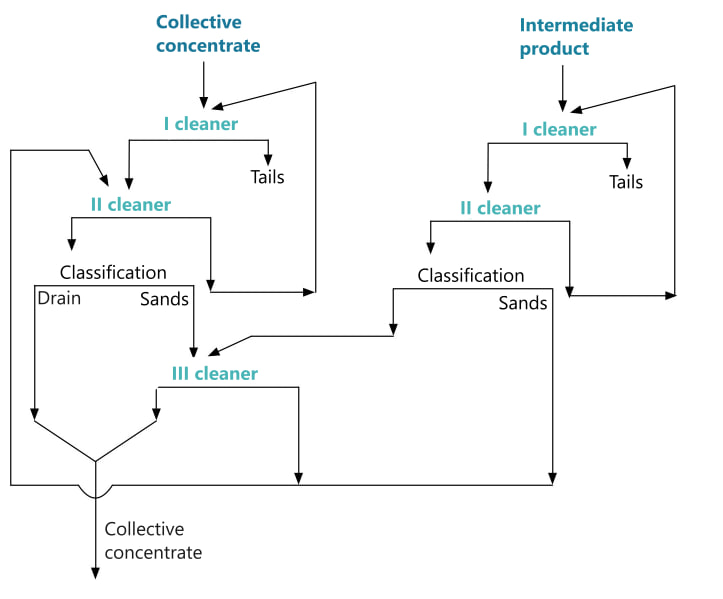
Fig. 1. Scheme of finishing of collective concentrates using classification
Reagent modes, like flotation schemes, in the enrichment of copper-zinc ores are determined to a large extent by the ratio of mineral forms of copper, the degree of activation of zinc sulfides, and the nature and degree of oxidation of iron sulfides.


