EN
Ore mining
Ore mining can be done both by open-pit mining (quarry mining) and by closed-pit mining (in mines). Ore mining can also be done by pumping liquids through the rock, which results in the ore being washed out of the rock – this process is called ore leaching. Let's look at these processes in more detail:
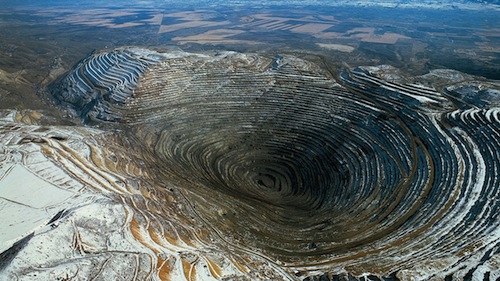
1) Open-pit (quarry) method – very common, and used when the ore is not deep in the earth's crust. A quarry is a huge pit designed for ore extraction.
Three characteristic zones of the quarry can be distinguished:
Quarry bottom – the quarry bottom is the platform of the lower bench of the quarry (the quarry sole). In conditions of development of steep and inclined bodies of minerals, it is determined taking into account the conditions of safe extraction and loading of rocks from the last bench: by width – not less than 20 m, by length – not less than 50 – 100 m.
The quarry depth is the vertical distance between the ground level and the quarry bottom or the distance from the upper quarry contour to the lower one. There are design, final and maximum quarry depths. The deepest quarries in the world have a depth of almost 1 km, for example, the Chuquicamata quarry (Chile) created for the extraction of copper ore has a depth of about 850 m. Fig. 1.
The ultimate contour of a quarry is the contour of a quarry during the period of its depletion, i.e. the cessation of work on the extraction of minerals and overburden.
2) Underground mining is a method of extracting minerals from the bowels of the Earth by constructing a system of underground mine workings (shafts). Extraction of minerals in mines was mastered by man in ancient times. The main processes of underground mining include:
- Opening up a mineral deposit includes drilling and mining.
- Preparation for excavation – work to ensure delivery of mined ore to the surface
- Cleaning excavation is the delivery of mined ore to the surface.
3) Ore leaching is the process of extracting rock from the depths of its occurrence by pumping aqueous solutions of inorganic acids (sulfuric, hydrochloric, nitric, etc.) through the rock mass. The leaching process can be divided into three stages:
- The supply of reactants to a solid surface is carried out by drilling wells in a certain geometric sequence and pumping the reagents mentioned above into them.
- Chemical reaction - chemical reaction of rock with aqueous solutions of acids
- Removal of soluble reaction products into solution (removal of the resulting solution to the surface for subsequent cleaning and enrichment work).
All of the above methods depend on the conditions of occurrence of the rock, its chemical composition, the composition of impurity (gutter) rock, as well as many other factors. For example, the quarry type of mineral extraction is advisable to use when the ore is located on the surface, but if the ore deposit is deep underground, then the underground type of deposit development is used. The leaching process also requires certain conditions, for example, it cannot be used if the rock containing the ore prevents the passage of aqueous solutions through it, as well as if there are reservoirs or rivers near the deposit, since pollution of natural objects may occur through underground waters, etc.