

EN
List of main radionuclides
A type of atom with a given number of protons and neutrons in its nucleus is called a nuclide. A radionuclide is a nuclide that has radioactivity.
Radionuclide sources of ionizing radiation are divided into closed and open.
- A sealed source of ionizing radiation (SSI) is a radionuclide source of ionizing radiation, the design of which prevents mutual contact between radioactive material and its surrounding environment and eliminates its contamination with radioactive substance above the permissible level under the conditions provided for the use of the source.
- An open source of ionizing radiation is a radionuclide source of ionizing radiation, the design of which allows contact between radioactive material and its environment and does not exclude the possibility of its contamination with a radioactive substance above the permissible level established for the open source of ionizing radiation under the conditions envisaged for its use.
The table provides a list of the main radionuclides used in X-ray radiometric analysis and their main nuclear-physical characteristics.
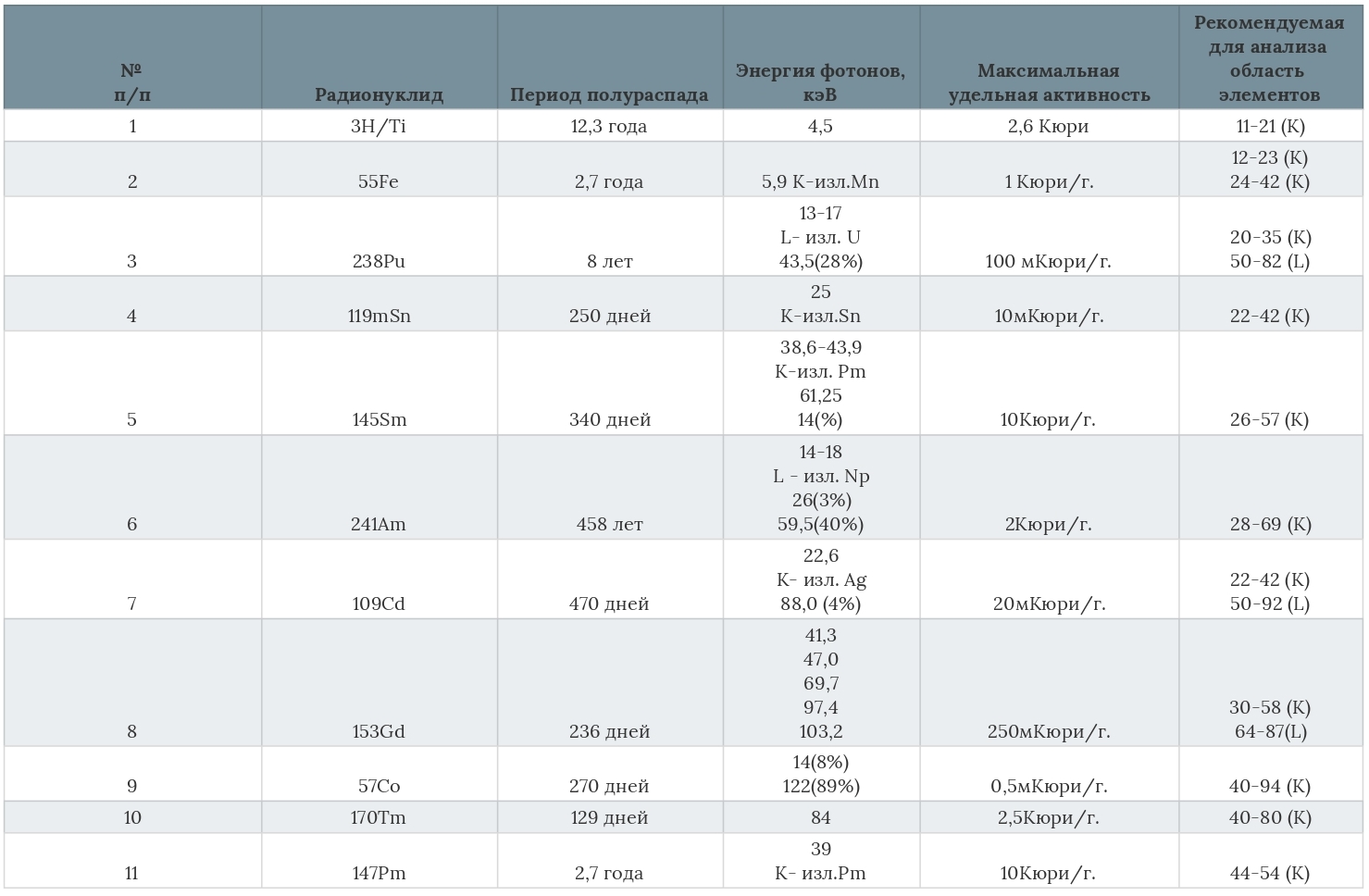
The excitation unit of the ARP-1C flow analyzer of ore and pulp contains one or several ZRNIs from the following series:
- cadmium-109 type РК109 РК 2.5 according to the "Methodology for categorizing sealed radionuclide sources by radiation hazard" Appendix No. 2 NP-067-16 correspond to categories 4 and 5,
- plutonium-238 of the IRIPL-3 type according to the "Methodology for categorizing sealed radionuclide sources according to radiation hazard" Appendix No. 2 NP-067-16 correspond to categories 4 and 5,
- americium-241 type IGIA-2 according to TU 95 1101-83,
- iron-55 type RZh 55.R09A.K. according to TU 95 1722-88.
The given ZRNI according to the methodology of categorization of ZRNI by potential radiation hazard RB-042-07 correspond to categories 4 and 5 - Hazard to humans is unlikely and Hazard to humans is very unlikely. The type and number of sources are selected depending on the task and the type of sensor used.


