

EN
Flotation of copper ores
Copper-zinc ores are a complex of copper, zinc, iron sulphides and minerals of host rocks. The main tasks in enrichment of copper-zinc ores are related to obtaining high-quality copper, zinc and pyrite concentrates with high extraction of copper, zinc and pyrite sulphur, respectively. Copper-zinc ores are among the most difficult objects of enrichment. These difficulties are caused by:
- Complex and rather close intergrowth of some sulphides, for the disclosure of which very fine grinding is required. For example, for disseminated sulphide ores of the Urals, the required grinding size is 90-96%, which is 0.074 mm. Insufficient degree of disclosure of intergrowths of sulphide minerals during grinding of some of them at some factories is also due to the multi-grade and variable composition of the mixture of processed ores, differing in their physical properties and grindability
- The similarity of flotation properties of copper sulfides and zinc sulfides activated by copper ions.
- Different flotation properties of different copper and zinc sulphides, which are caused by differences in the nature of their surface, oxidation ability and the required concentration of the collector during flotation. The reasons for the different flotation properties of sphalerite varieties are the different content of isomorphic impurity of iron (from 0 to 20%), cadmium (up to 2.5%), indium and other elements. Thus, constant monitoring of impurity elements in the ore is necessary.
- Inconsistency of the material composition of ores in terms of the content of primary metals, sulfides and secondary copper minerals.
Depending on the specific features of their material composition, various sulfhydryl collectors and combinations of cyanide, sodium sulfide, sulfoxide compounds, ferrocyanide, zinc or iron sulfate, etc. are used as reagents in the selective flotation of copper-zinc ores. A combination of several depressant reagents is characteristic of the flotation of copper-zinc ores.
When processing copper-zinc-pyrite ores, both direct selective and collective flotation schemes are used. The choice of scheme is determined by the material composition of the ore, the nature of the inclusion of sulphide minerals, the degree of their oxidation, the content of pyrite and secondary copper minerals.
When enriching primary disseminated solid pyrite ores with a low content of secondary copper sulfides, insignificant activation of zinc sulfides and the possibility of opening minerals without excessive fine grinding, a direct selective flotation scheme with sequential separation of copper, zinc and pyrite concentrates is used. Obtaining the highest technological indicators according to this scheme is due to the fact that it is easier to separate copper sulfide minerals from zinc ones before the activation of zinc sulfides, which would be required in the case of collective flotation.
If copper-zinc ores have a high content of secondary copper sulphides (most deposits in the Urals, Kazakhstan and Japan), then the best enrichment results are obtained using collective-selective flotation schemes. The difficulties that arise in using a direct selective flotation scheme in this case are due to the fact that during the grinding and flotation process, covellite and chalcocite, being intensively oxidized, cause strong activation of zinc and iron sulphide minerals, significantly complicating their depression in the copper flotation cycle.
In the case of a pronounced “natural” activation of zinc sulphides, a large and variable content of soluble copper salts and sludge material in the ore, and complex intergrowth of separated sulphides, the most rational scheme is one with preliminary collective flotation of all sulphide minerals (Fig. 1).
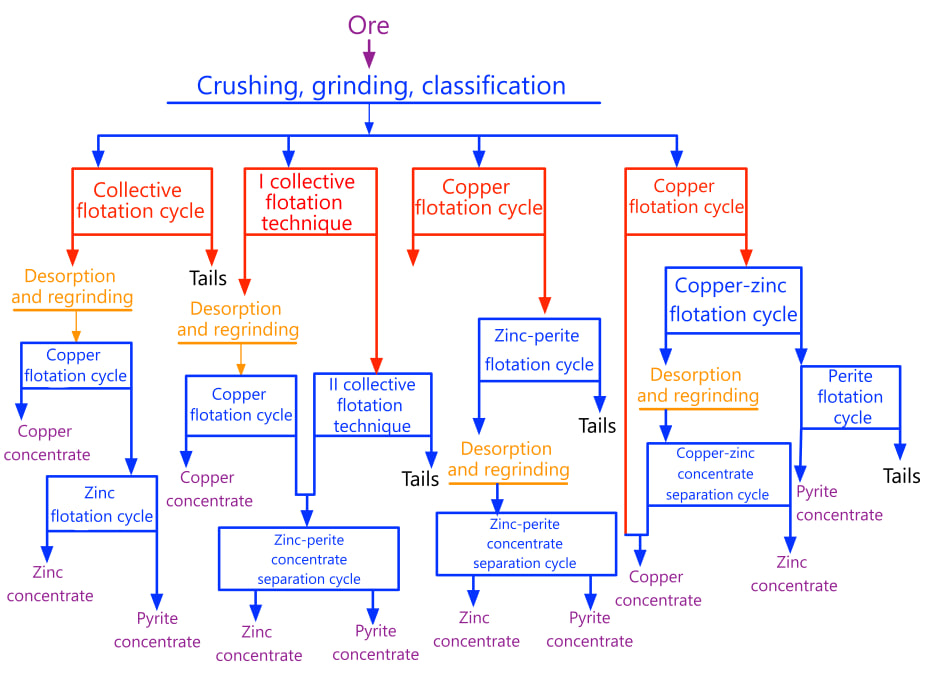
Figure 1. Scheme with preliminary collective flotation
A characteristic feature of all variants of copper-zinc ore enrichment schemes is multi-stage grinding and flotation, additional flotation in a separate cycle of copper sulphide varieties lost in the tailings of copper concentrate cleaning, additional flotation of the non-activated variety of sphalerite, and inter-cycle flotation.
Reagent modes, as well as flotation schemes, in the enrichment of copper-zinc-pyrite ores are determined to a large extent by the ratio of mineral forms of copper, the degree of activation of zinc sulfides, and the nature and degree of oxidation of iron sulfides. The main difficulties in this case are associated with the separation of copper and zinc sulfide, the results of which are directly dependent on the effectiveness of preventing the activation of non-activated and deactivation of activated zinc blende under the action of the loaded reagents.
Industrial methods of selection of copper and zinc minerals are based mainly on depression of zinc sulfides. For this purpose, cyanide and cyanide-free reagent regimes are used.
In order to improve the quality of the obtained concentrates, save technical, energy resources, and time, continuous control of the component composition of the substance without time delays is necessary. This control should be carried out on the conveyor using flow analyzers of the substance, allowing continuous receipt of data on the qualitative and quantitative component composition of the ore. The company OOO TekhnoAnalitPribor produces a flow analyzer of ore ARP-1C, which delivers to cope with the tasks set.


