

EN
Copper-nickel ore beneficiation technology
Currently, 53 nickel minerals are known, most of which formed at high temperatures and pressures, as well as during the solidification of magma or precipitation from hot aqueous solutions. Nickel is also included as an isomorphic impurity in several dozen minerals containing divalent iron and magnesium.
However, the bulk of nickel is extracted from ores in the form of sulphide minerals and silicates, the characteristics of which are given in the table.
The main volume of nickel is mined in deposits of magmatic sulphide copper-nickel ores (65% of the total amount of nickel mined from ores). The main minerals in the ores of these deposits are pyrrhotite, pentlandite, chalcopyrite, magnetite, pyrite, cubanite, polydymite, nickeline, millerite, violarite, as well as platinum group minerals, galena, sphalerite and bornite are also found. In Russia, ores of this type are located on the Kola Peninsula and in the Norilsk region. Sulfide copper-nickel ores are mined in Canada, where there are about 40 deposits of this type, in South Africa, Australia, Finland, Sweden, Norway, and the USA. The nickel content in sulphide ores ranges from 0.3 to 4%, and the copper-nickel ratio in low-copper ores ranges from 0.5 to 0.8, and in high-copper ores from 2 to 4. In these ores, in addition to copper and nickel, cobalt is ubiquitous, as well as gold, platinum, palladium, ruthenium, selenium, tellurium, etc.
Characteristics of the main nickel minerals
| Mineral | Formula | Mass fraction of Ni,% | Density, g/ cm3 | Hardness |
|
Pentlandite Pyrrhotite nickeliferous Millerite Nickelin Polydymite Violarite Garnierite |
(Fe,Ni)9S8 From Fe6S9 to Fe11S12 NiS NiAs Ni3S4 Ni2FeS4 Ni4(Si4O10)(OH)4∙4H2O |
31,22 0.25–14.22 64,67 43.9 57.86 38.94 40.68–46.6 |
4.5–5.0 4.6–4.7 5.2–5.6 7.6–7.9 4.5–4.8 4.5–4.8 2.27–2.93 |
3–4 3.5–4.5 3.0–3.5 5.0–5.5 4.5–5.0 4.5–5.0 2.0–3.5 |
Depending on textural features, sulphide ores are divided into the following types:
Disseminated ores are the most common of the nickel sulfide ores. The sulfide minerals in these ores are distributed between serpentinized olivine and pyroxene. The nickel, copper, and cobalt ratio is 55–50:28–23:1.
Brecciated ores are a type of rich industrial ores. Their content in ore bodies varies from 2 to 25%. The ores consist of fragments of talcified serpentinites, phyllites and tuffites cemented by a fine-grained sulphide mass consisting of pyrrhotite, pentlandite and chalcopyrite, the content of which is 60–75%. The ratio of nickel, copper and cobalt is 56:22:1.
Solid sulphide ores are closely associated with brecciated ores in the lower parts of the ore bodies. They consist mainly of pyrrhotite (60–80%), pentlandite and chalcopyrite. The grain size of pentlandite can reach 5–10 mm. The ratio of nickel, copper and cobalt in the ores is 35–25:17–14:1.
Vein-disseminated and vein ores are not widely distributed. They are distinguished by fine mutual intergrowth of the main sulphide minerals – pyrrhotite, chalcopyrite and pentlandite. The ratio of nickel, copper and cobalt is usually 47:48:1.
Silicate nickel ores are characterized by a low nickel content (up to 1%) with a nickel to cobalt ratio of 20...30:1. Nickel extraction from silicate ores in total nickel production is no more than 15...20%, and these ores are processed without preliminary enrichment.
Copper-nickel ores are enriched using direct selective, collective-selective and combined schemes.
The solid ores of the Komsomolsky mine are enriched using the selective flotation scheme.
These ores are characterized by different flotation activity of sulphide minerals, which can be arranged in decreasing flotation in the following sequence: chalcopyrite (talnakhite, moyukite, cubanite), pentlandite and nickel-bearing pyrrhotite, pyrrhotite. Selective flotation of copper and nickel minerals occurs primarily due to different oxidation rates of the sulphide surface. Nickel sulphide minerals are well and quickly oxidized, while chalcopyrite is oxidized much more slowly.
Solid sulphide ores of the Komsomolsky mine after medium and fine crushing are sent for grinding, which is carried out in two stages to a size of 80% of the -0.05 mm class. The solid content in the discharge from hydrocyclones of the second grinding stage reaches 20%, therefore the discharge is thickened to 34% solid, while about 50% of the water is removed. The thickened product then goes to three contact tanks, where air is supplied to oxidize the surface of the sulphide minerals. After mixing for 15 minutes, nickel minerals are suppressed and the flotation activity of copper sulphide minerals increases somewhat. The first main flotation is carried out in the presence of ethyl dithiophosphate (7 g per 1% Cu), T-66 (12 g / t) and MIBK (6-10 g / t). After control flotation, where sulphide mineral aggregates are additionally extracted into the froth product by feeding ethyl dithiophosphate (1.5 g per 1% Cu) and T-66 (2 g/t), tailings are separated and sent to the first flotation of pentlandite, where its large grains are extracted with xanthate (25 g/t). The tailings of the first flotation of pentlandite are additionally ground to a size of 92% class -0.044 mm with preliminary and verification classification to prevent its sliming. The tailings of the second pentlandite flotation are a finished pyrrhotite concentrate containing 2% Ni and 0.4% Cu.
Finished nickel concentrate is a froth product of pentlandite flotation and tailings of rough copper flotation, the feed of which is concentrate I of pentlandite flotation. The resulting nickel concentrate contains 7.0–7.2% Ni and 2.3% Cu.
Copper concentrate is extracted from the control flotation concentrate after regrinding to 92% of the -0.044 mm class together with the rough copper flotation concentrate. After the second main and two cleaning operations, the resulting copper concentrate contains 26–28% Cu and 1.7–1.9% Ni. The total nickel concentrate contains 8.0–8.5% Ni and 4.4–4.7% Cu. To suppress pentlandite, lime is fed into the rough copper flotation, the total consumption of which according to the scheme is 0.5 g/t.
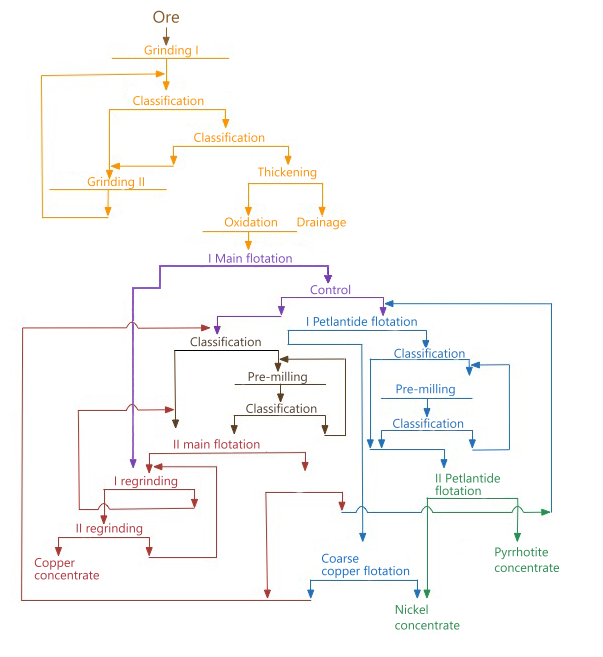
Flotation scheme of continuous sulphide copper-nickel ores
Disseminated copper-nickel ores are enriched using the collective flotation scheme to obtain a collective copper-nickel concentrate, which, depending on the copper-nickel ratio, is selectively separated into copper and nickel concentrates or smelted to obtain converter matte. If the copper-nickel ratio is greater than two, the collective concentrate is selectively separated, but if this ratio is less than two, the concentrate is smelted to obtain converter matte, which is then separated using the I.N. Maslyanitsky method.
According to the collective flotation scheme, ore is crushed in stage I to 40–50% of the -0.074 mm class, after which the ore is sent to intercycle flotation, which is carried out in an alkaline medium at pH 9–10. Collectors (butyl, amyl xanthates, butyl dithiophosphate or their combinations) are best fed to mills, where they can interact with the freshly exposed surface of pyrrhotite, which is capable of rapid oxidation.
Subsequent rough flotation is carried out with additional grinding of inter-cycle flotation tailings to a size of 60–80% of the –0.074 mm class. Inter-cycle and rough flotation are usually carried out in an open cycle, and middlings are processed in a separate cycle with additional grinding to 90–100% of the –0.074 mm class. The concentrates obtained in this cycle are combined with the concentrates of the rough flotation. Sometimes, to improve the technological indicators of enrichment, separate flotation of sands and sludge is used with the supply of an additional collector – apolar oil (kerosene, machine oil, etc.). The collective flotation scheme is used at the Zhdanovskaya enrichment plant, where poor disseminated copper-nickel ores of the Zhdanovsky deposit are processed.
The Zhdanovskaya enrichment plant was put into operation in 1965. The process flow chart for enriching copper-nickel ores at this plant is shown in Fig. 49. Ore with a size of 1,200 mm is crushed in three stages to 25 mm. The first stage of crushing is carried out in a KKD-1500/180 cone crusher, where the ore is fed by 100-ton dump cars. Coarsely crushed ore is sent to the medium and fine crushing building, where three KSD-2200B crushers and six KMD-2200 and KMD-2200 crushers are installed in cascade. Preliminary screening before fine crushing is carried out on six 173-Gr inertial screens.
After stage I grinding in ball mills МШР-3600Х5000 operating in a closed cycle with a spiral classifier (one double-spiral classifier with a diameter of 3,000 mm for two mills), to a size of 45–50% of the -0.074 mm class, the pulp with a solid content of 41–43% is sent to intercycle flotation. To create an alkaline environment, soda ash (710 g/t) is fed to the mills, and butyl xanthate (60–75 g/t) is also introduced here as a collector. To activate nickel sulfides, copper sulfate (up to 9 g/t) and butyl dithiophosphate (7–20 g/t) are fed to intercycle flotation.
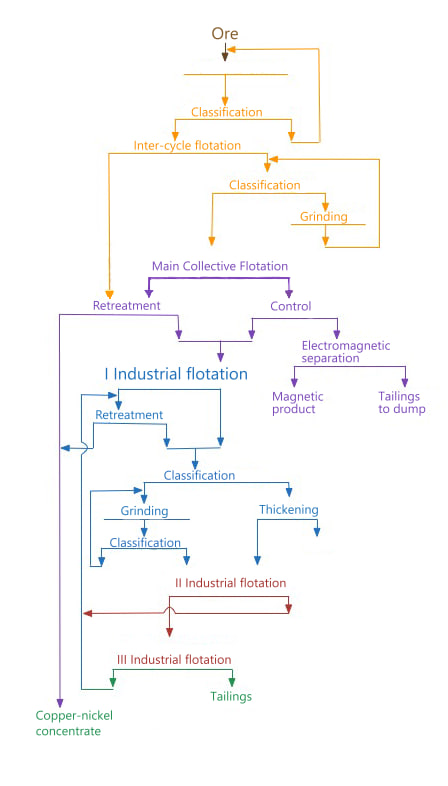
Technological scheme of collective enrichment of copper-nickel ores
The tailings of inter-cycle flotation are regrind in ball mills МШЦ-3600Х5500, operating in a closed cycle with hydrocyclones ГЦ-50. Butyl xanthate (40–50 g/t) is fed to the mills of stage II. The hydrocyclone overflow with a size of 80–85% of the –0.074 mm class is sent to the main bulk flotation with the feed of copper sulfate (0–9 g/t) and butyl dithiophosphate (5–15 g/t). Concentrates of inter-cycle and main bulk flotation are combined and re-cleaned with the suppression of gangue minerals by CMC, which is fed to each cleaning flotation at a total consumption of 400–560 g/t. The resulting collective copper-nickel concentrate contains 5.8–6% Ni, 2.3–2.75% Cu and up to 0.2% Co with copper and nickel extraction of about 75% and cobalt of 65%.
The tailings of the main bulk flotation are subjected to a control flotation, where copper sulfate (0-5 g/t), butyl xanthate (8-10 g/t) and butyl dithiophosphate (0-5 g/t) are fed. Magnetite is extracted from the tailings of the control flotation by magnetic separation in a drum magnetic separator at a magnetic field strength of 80-96 kA/m. Mid-size products (tailings of the cleaning and concentrate of the control flotation) are re-crushed to a size of 90% of the -0.044 mm class and floated in a separate cycle. After cleaning the concentrate of the mid-size flotation, which is carried out in the presence of CMC (150 g/t), the froth product is added to the copper-nickel concentrate.
The finished copper-nickel concentrate, after thickening, is fed to the roasting shop for pelletizing and thermal strengthening of pellets, which are then sent to metallurgical production.


